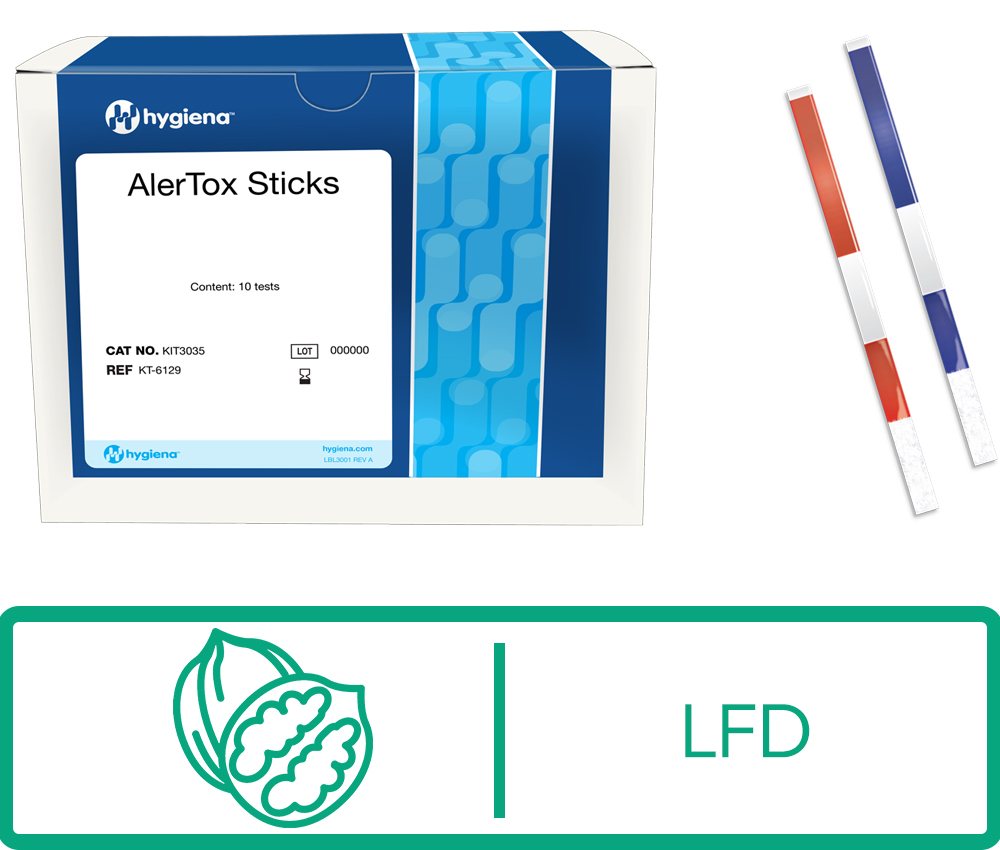
Sale! Hygiena AlerTox® Sticks Walnut (expiring 15 Aug 2026)
$200.00 Original price was: $200.00.$100.00Current price is: $100.00.
SKU
KT-6192 / KIT3092
Categories All, Ambient, ATX-Sticks, Hygiena, Industry Use, LFD (Rapid Test), No Equipment Required, Walnut
Description
Hygiena AlerTox® Sticks Walnut
- KT-6192 / KIT3092
- Rapid test for the detection of Walnut
- 10 tests for ingredients, finished products, or surfaces
- Qualitative Results. LOD: 2.25ppm
Sale while supplies last! 50% off AlerTox Sticks Walnut kits, expiring 15 August 2026!
- Quick: A reliable answer in less than 15 minutes
- Easy: No additional equipment required
- Reliable: Shelf-stable and robust
- Cost efficient: competitive pricing and volume discounts available
- AlerTox ELISA kits available for 20+ allergens
- Validation data available on request
AlerTox® Sticks are available for the following common food allergens:
- Almond
- Crustacean
- Egg
- Fish
- Hazelnut
- Milk
- Mustard
- Peanut
- Sesame
- Soy
- Walnut
The AlerTox line of test kits includes 20+ ELISAs for allergens, including peanut, coconut, lysozyme, ovalbumin and more. Contact us for details.
Yes. Some matrices are very challenging for allergen rapid tests. Always read the kit IFU before beginning to test, and contact us with any questions.
The AlerTox Sticks Crustacean test is applicable for qualitative detection of target antigens in the samples of complex foods and surface swabs. The sensitivity of the test may decrease in case of heat-processed food or fat-rich samples (e.g. in presence of oil or cream). Some fish processing technologies, eg preparation of surimi, selectively deplete the antigen (tropomyosin), sometimes resulting in weak positive or even false negatives.
The AlerTox Sticks Egg kit recognizes Ovalbumin, which is a glycoprotein that comprises 54% of the total proteins of egg white. AlerTox Sticks Egg will not detect the allergen presence in samples that have been exposed to high heat for an extended period. (higher than 212°F for more than 30 minutes.)
It is impossible to manufacture a single kit that can recognize all species of fish, or all manufacturing conditions (boiled, in oil, in vinegar, dried etc). Although AlerTox Sticks Fish can recognize between 30-50 types of bony fish, some show a reduced response in certain manufacturing processes. Canned tuna and surimi, or crab stick, are particularly difficult to detect. Please contact us with information about the matrices you are testing. We’ll be able to help determine whether or not the kit will fit your needs.
AlerTox Sticks Mustard tests can detect mustard content of 1ppm, measured as ground raw unprocessed mustard seed. The test kit will detect the presence of all related plants, but will not detect the presence of mustard greens.
AlerTox Sticks Almond, Hazelnut, Walnut and Peanut
The sensitivity of all of the nut detection tests decrease in an environment rich in fats (for example, in the presence of oil or creams). Testing for residue from nut oils is extremely challenging and may show false negatives.
- AlerTox Sticks Almond shows a considerable cross-reactivity in pit extracts of the fruits of Prunus and related genuses: peach, plum and apricot. If these pits are crushed during industrial processing of fruit masses (for example, in the production of jam), the resulting material may show false positivity with AlerTox Sticks Almond.
- AlerTox Sticks Hazelnut does not detect hydrolyzed, low molecular weight fragments of the target protein and therefore it could show a false negative result with fermented hazelnut milk. The sensitivity of the test decreases in an environment rich in fats (for example, in the presence of oil or creams).
- While AlerTox Sticks Peanut used to have several allergen cross-reactivities, it has been reformulated. Be advised that sensitivity will be different depending on the degree to which the peanut has been roasted.
AlerTox Sticks Sesame The sensitivity of the AlerTox Sticks Sesame test decreases in an environment rich in fats (for example, in the presence of oil or creams). The kit should not be used to detect sesame oil.
AlerTox Sticks Soy senses the presence of trypsin inhibitor from soybeans (STI) with a sensitivity of 100 ng / g (0.1 ppm). This inhibitor is denatured only in presence of high temperatures. There is no process to remove 100% of STI, although UHT processes significantly reduce the amounts of STI, making it undetectable to the kit. The kit should not be used to detect soy lecithin or soy oil.
Quite easy! View the video below, or contact us to set up a training demonstration.
Generally speaking, allergen test kits are designed to detect traces of allergenic protein. Food or beverage samples that are very high in allergenic proteins (eg more than 5,000-10,000 ppm) may incur a false negative in the form of a hook effect. This is because matrices containing a very high amount of the allergen can overwhelm the test strip. If you suspect this to be the case, an option is to dilute the sample (1 part sample to 10 parts buffer or water, for example) and re-test. You can always contact us with questions.
After the test was completed, the test strip showed a negative result (only the blue control line appeared). But when I checked the test strip the next day, I noticed a faint positive line. What’s going on?
The test results should be read at the time indicated in the manual for each allergen test (not before and not after). Any faint lines that appear after this time limit are not valid and do not indicate the presence of allergen in the sample. Conversely, positive results may fade in intensity after the time limit.
I got a test result that surprises me. What do I do?
If your results are unexpected, please email us with more information about your test. We’ll work with you until your questions are resolved.
There aren’t any easy one-size-fits-all solutions to effectively control hazard points in the manufacturing process. Minimizing hazard points and identifying best practices takes experience and expertise.
While Emport LLC does not design site-specific plans, we’re happy to talk about general best practices. Simply book time for a conversation.
If you prefer to read: The FDA provides guidance documents that cover basic questions about compliance to FDA legislation.
You can also reference Emport’s article Best Practices for Gluten-Free Manufacturers, which provides a fuller explanation of some of the key concepts in creating a hazard plan.
Orders generally ship within 2 business days. If expedited service is required, please contact us to confirm availability.
All sales are final once shipped. For more information, please see our Terms & Conditions.
To ship internationally contact us for a quote and to confirm availability.
If shipping to a Canadian address, please visit glutentox.net.
Contact us for CoAs, SDS and validation sheets.
Search our Document Library for Manuals, IFUs and more.